
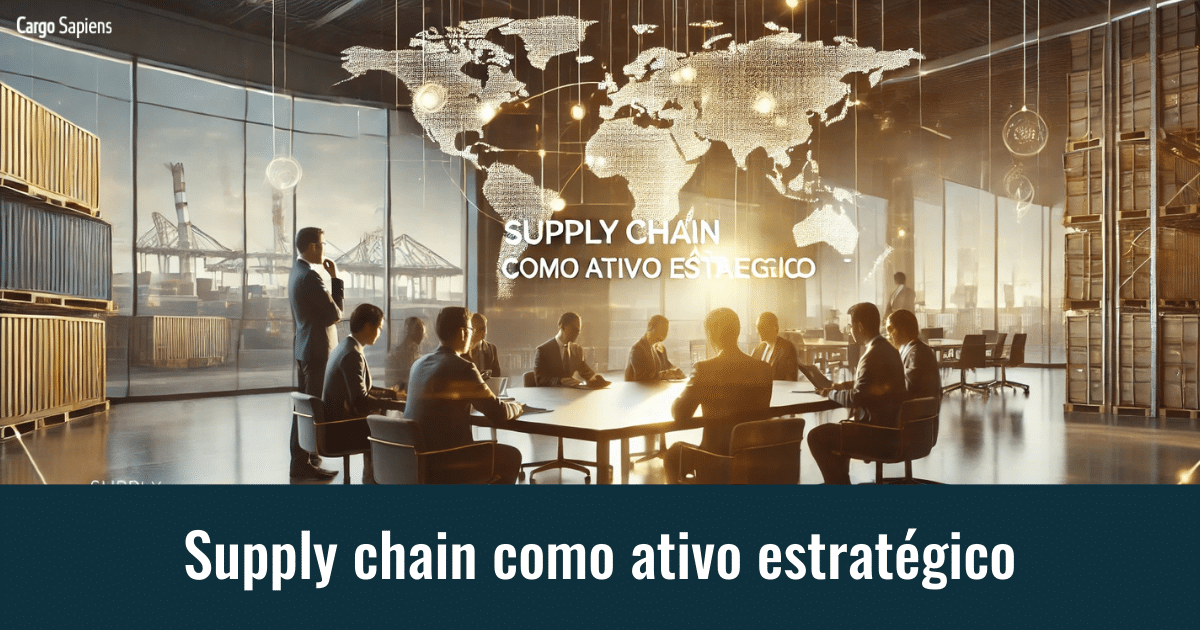
Supply chain as a strategic asset It has ceased to be merely an aspirational concept and has come to reflect a concrete change in the way companies make decisions regarding growth, investment, and risk management.
By 2026, logistics and supply chain management will play a central role in corporate competitiveness, directly influencing financial results and market positioning.
For boards and C-level executives, treating the supply chain as a strategic asset means recognizing that logistics decisions impact international expansion, operational resilience, and long-term business sustainability.
What global data shows about supply chain as a strategic asset.
Recent researches These findings indicate that global leaders are more confident in the growth of international trade, even in an environment marked by geopolitical volatility, high costs, and increased regulatory complexity.
According to the Global Trade Observatory Annual Outlook Report 2026Global trade executives remain optimistic about growth in 2026, but acknowledge that this growth will only be viable for companies that deal with... supply chain as a strategic asset, with a focus on resilience, adaptation, and continuous investment.
According to analysis According to a report released by DP World, supply chain performance will be a decisive factor for companies' competitiveness in the coming years, especially in scenarios of global instability.
Why supply chain as a strategic asset entered the board's agenda.
The elevation of this topic to the board level is no accident. When supply chain is treated as a strategic asset, it directly influences critical variables monitored by the board:
- Financial margin and predictability;
- ability to serve strategic markets;
- exposure to geopolitical and regulatory risks;
- operational continuity in disruptive scenarios;
- return on investment in expansion and infrastructure.
Ignoring this integrated vision creates silent risks that rarely appear in financial reports, but quickly materialize in times of crisis.
From operational efficiency to growth engine.
More mature companies have already understood that supply chain as a strategic asset It goes far beyond cost reduction. It becomes an instrument to enable sustainable and scalable growth.
This is reflected in decisions such as:
- Diversifying suppliers to reduce critical dependencies;
- exploration of new trade routes and corridors;
- investments in technology to gain visibility and predictability;
- Integration between logistics, finance, and strategic planning.
In this model, the supply chain stops reacting to the business and starts supporting it.
The specific impact on Brazilian companies
For Brazilian companies included in international trade, treat supply chain as a strategic asset This is even more relevant. Dependence on imported inputs, distance from major consumer markets, and regulatory complexity amplify the impact of any logistical weaknesses.
At the same time, organizations that structure their supply chain with a strategic vision are able to reduce exposure to risks, increase global competitiveness, and respond more quickly to market changes.
In this context, supply chain as a strategic asset It is establishing itself as a real competitive advantage for companies operating in complex and volatile environments.
Reflections for boards and executives
Given this scenario, some questions need to be regularly on the board's agenda:
- Does our company treat supply chain as a strategic asset or merely as an operational task?
- We have enough visibility to anticipate risks and sustain the planned growth?
- Are logistics decisions integrated into the long-term corporate strategy?
The answers to these questions determine the level of resilience and competitiveness of companies in the coming years.
Conclusion
The global scenario for 2026 reinforces that supply chain as a strategic asset It's no longer a choice, but a condition for sustainable growth. Leaders who integrate logistics into corporate strategy are able to transform volatility into a competitive advantage.
For boards and C-level executives, elevating the supply chain to the center of decision-making is an essential step to sustain results in an increasingly uncertain global environment.
Do you want to assess whether your company already treats its supply chain as a strategic asset?
Learn how Cargo Sapiens It helps leaders gain visibility, anticipate risks, and make decisions based on reliable data.