
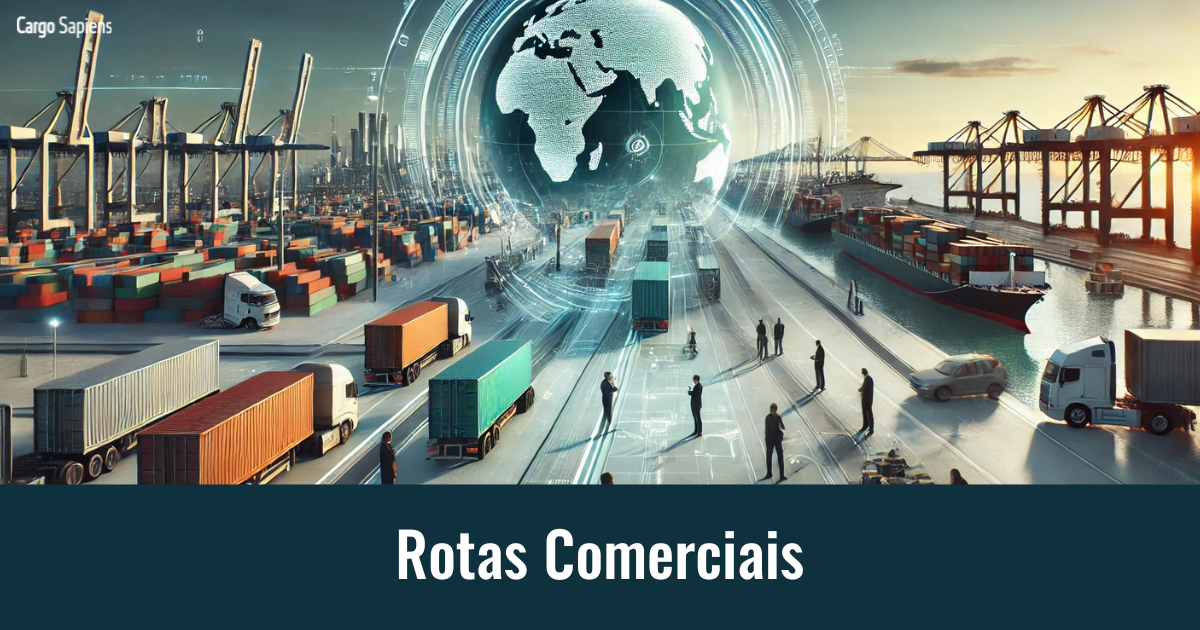
Trade routes They are not merely a choice of path. They define the total cost of service, the predictability of deadlines, and exposure to risks that do not appear in freight negotiation. In a world where more than 80 % Given that the volume of global trade is transported by sea, the geography of trade becomes a strategic variable for margins and resilience.
For the board, the central point is simple: the company doesn't compete solely on product and price. It competes on logistics corridors, the ability to overcome disruptions, and the governance of trade-offs (cost, time, and risk) before urgency dictates.
Why trade routes have become an executive priority
Chokepoints and disruptions are no longer "rare events"
The global economy depends on critical waterways. The Strait of Hormuz, for example, will handle approximately 20 million barrels/day of oil flow in 2024, equivalent to approximately... 20 % of global consumption of petroleum liquids. This type of concentration makes geopolitical risk a cost risk.
In container trade, the Suez Canal is another emblematic case: attacks and tensions in the Red Sea have reduced traffic and forced diversions, and the IMF Remember that around 15% of the volume of global maritime trade normally passes through the Suez Canal, with detours increasing delivery times by 10 days or more, on average.
For C-level executives, this changes the framework: the question is not "whether there will be disruption," but "how prepared is your company to absorb the impact without destroying margins and..." predictability".
Time and variability are financial costs, not just operational costs.
O World Bank It is estimated that, on average, 44 days pass from when a container enters the port of the exporting country until it leaves the port of destination, with a standard deviation of 10,5 days, representing 60% of the total time of international trade.
In boardroom terminology, this translates to two effects:
- Capital and inventory in transit for longer periods;
- buffers to compensate for uncertainty (variability), which increase total cost and reduce flexibility.
How geography redefines cost, time, and risk.
Cost: "Shipping" is only one part of the journey.
Trade routes They determine not only the fare, but also:
- ancillary costs (fees, storage, demurrage/detention, inspections);
- risk of exceptions (rescheduling, overbooking, no-shows, lack of available time slots);
- Coordination costs (team time, rework, back-and-forth with suppliers).
When the route is unstable, the company pays an "invisible premium" in the form of urgency and exception. In recent disruptions, the UNCTAD He highlighted that route reconfiguration and route extension increase costs and put pressure on supply chains and inflation.
Deadline: what matters is reliability, not average.
Average transit time is a weak metric if variability is high. Trade routes Multiple transshipment points, congested ports, or greater exposure to geopolitical events tend to lead to greater dispersion.
For the board, the correct question is no longer "what is the lead time?" but rather:
- What is the reliability per aisle?
- What is the time dispersion and its total cost?
- What is the cost of failure (disruption, penalty, revenue loss, customer impact)?
Risk: the route is an exposure decision.
Trade routes They define exposure to:
- geopolitical risk (chokepoints, sanctions, conflicts);
- Climate risk (restrictions on channels/rivers, extreme events);
- regulatory risk (documentation, traceability, market-specific requirements);
- Capacity risk (dependence on a few shipping companies, airlines, terminals).
A route might be "cheaper" and still be worse for the company if it increases the likelihood of exceptions and emergencies.
What more mature companies do with trade routes
They treat routes as a portfolio, not as a one-off decision.
Instead of a single policy, they define a strategy by clusters:
- Critical corridors (revenue, strategic customer, production): prioritize reliability and pre-defined alternatives;
- Tactical corridors: optimize cost with flexibility;
- Opportunistic runners: they use spots with clear rules and limits.
This allows the company to have discipline in trade-offs before the pressures of daily life.
They define rerouting triggers and alternative plans.
Following disruptions like those in the Red Sea, route reconfiguration (e.g., circumnavigating the Cape of Good Hope) has become a resilience practice, even with its impact on timelines. The executive point is to formalize it:
- when to activate the alternative;
- how to price the impact (timeframe, cost, risk);
- Who decides and with what data?
They measure the total cost per runner with discipline.
The board should require that route decisions be evaluated by total cost of serving, including:
- Direct costs (shipping and fees);
- Variability costs (inventory, buffers, exceptions);
- costs compliance and confidentiality (rework, document delays, audit);
- Urgent costs (alternative mode of transport, emergency dispatch).
Without this vision, the company optimizes one line and worsens the overall result.
Board checklist for governing trade routes
1. Map concentration and dependencies
- What are the 10 corridors that most impact revenue and continuity?
- What is the dependence on port, canal, transshipment, and capacity provider?
2. Define trade-off policy per corridor cluster.
- Where is cost the priority and where is reliability the priority?
- What is the acceptable limit of variability by product/customer type?
3. Establish data-driven decision governance.
- Decisions by corridor require comparability (same cost and scope basis).
- Events and exceptions need to become learning experiences, not just fires.
- Executive metrics need to capture dispersion, not just averages.
4. Make “resilience” measurable.
- Time to reroute with pre-arranged Plan B.
- Financial impact of simulated disruptions by corridor.
- Approved and actionable alternative capacity.
Is your company already able to compare scenarios by aisle with a clear understanding of total cost, timeline, and risk before contracting freight services?
Get to know Cargo Sapiens And see how to standardize quotes, increase transparency, and accelerate decisions with more predictability in critical trade routes.