
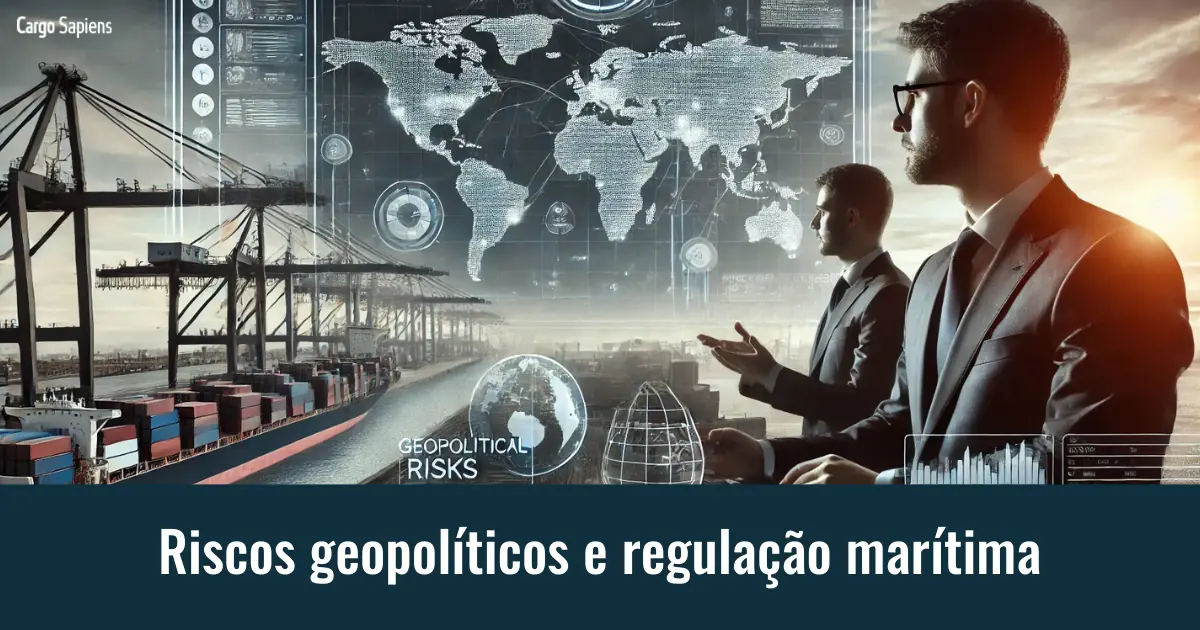
For a long time, geopolitical risks Regulatory changes in maritime transport were treated as external events, closely monitored by operational areas and logistics partners. By 2026, this logic no longer applied.
The combination of persistent geopolitical tensions, increased regulatory intervention, and the fragility of global routes has transformed international transport into a critical risk factor for companies operating global supply chains.
For boards and C-level executives, ignoring this scenario means accepting higher levels of financial, operational, and reputational exposure.
What has changed in the geopolitical and regulatory environment?
Maritime transport has always been subject to international risks, but what we are seeing today is a change in scale and frequency. Regional conflicts, trade disputes, and economic sanctions have begun to directly impact strategic corridors of global trade.
Routes that were once considered stable have become more vulnerable to disruptions, forced detours, and increased costs associated with insurance, risk premiums, and transit time.
Meanwhile, regulatory authorities have been expanding their scope of action in the maritime sector. The focus is not only on competition or commercial practices, but also on safety, sustainability processtraceability and compliance with increasingly complex international rules.
This movement creates an environment in which logistical decisions cease to be merely technical and begin to have legal, financial, and strategic implications.
As reported by Wall Street Journal“The new leadership of the Federal Maritime Commission plans to broaden the agency’s focus to global geopolitical risks affecting shipping, including threats at critical navigation points and operations of ‘shadow’ fleets transporting oil from countries like Russia and Iran,” highlighting growing regulatory concerns about the stability of global supply chains.
Why does this scenario directly affect Brazilian companies?
Brazilian companies feel this impact in an amplified way. The dependence on maritime transport for importing inputs and exporting commodities, combined with long distances and less route flexibility, increases exposure to external geopolitical and regulatory events.
Furthermore, changes in international regulations often generate indirect effects in Brazil, such as port delays, the need for contractual adjustments, reviews of logistics suppliers, and increased total transportation costs. For the board, this translates into greater unpredictability regarding deadlines, costs, and associated risks. international operation.
The invisible risk: decisions without executive visibility.
One of the biggest problems in this scenario is information asymmetry. In many organizations, geopolitical risks Regulatory and other issues remain concentrated at the operational level, without reaching the board table in a structured way. When this happens, strategic decisions are made based on incomplete or outdated information.
The result is well known: exposure to unmapped risksInflexible contracts, difficulty reacting to crises, and a direct impact on margins and operational continuity. For companies with global operations, this type of invisible risk is as critical as financial or currency risks.
The new role of logistics in corporate risk management.
In this context, logistics takes on a central role in governance Corporate. It becomes a fundamental link between strategy, risk, and execution, allowing the board to have clarity on:
- Real logistics costs and their volatility;
- dependence on specific routes, modes of transport and suppliers;
- Regulatory impacts on contracts and operations;
- Ability to respond to unexpected events.
More mature companies already treat logistics and supply chain as an integral part of their frameworks. risk management corporate.
How are leaders preparing for this scenario?
Organizations that are best able to navigate this environment adopt some clear practices:
- centralization of decisions and logistics data;
- Consolidated visibility of routes, contracts, and costs;
- Auditable processes aligned with compliance;
- Using historical data to simulate risk scenarios;
- Integration between logistics, finance, and strategy.
The key point is not to eliminate risks, but to know them, measure them, and manage them in advance.
Reflections for boards and executives
In a more unstable global environment, the key question for the board is not whether there will be new geopolitical or regulatory crises, but rather:
- Do we have sufficient visibility to understand how these risks affect our logistics operations?
- We get anticipate impacts Before they reach the financial result?
- Do our processes allow for quick and well-informed decisions in times of crisis?
Companies that can answer these questions strengthen their resilience and competitiveness. The others continue to react to external events.
Conclusion
Geopolitical risks Maritime regulation and management are no longer peripheral issues. They have come to directly influence strategic decisions, financial planning, and business continuity.
For Brazilian companies involved in international trade, bringing logistics to the center of the executive agenda is essential to reduce exposure and sustain growth in an increasingly complex global environment.
Do you want to understand how geopolitical and regulatory risks impact your company's logistics today?
Find out how Cargo Sapiens It can help leaders gain visibility, control, and intelligence for strategic decisions in highly complex scenarios.
