
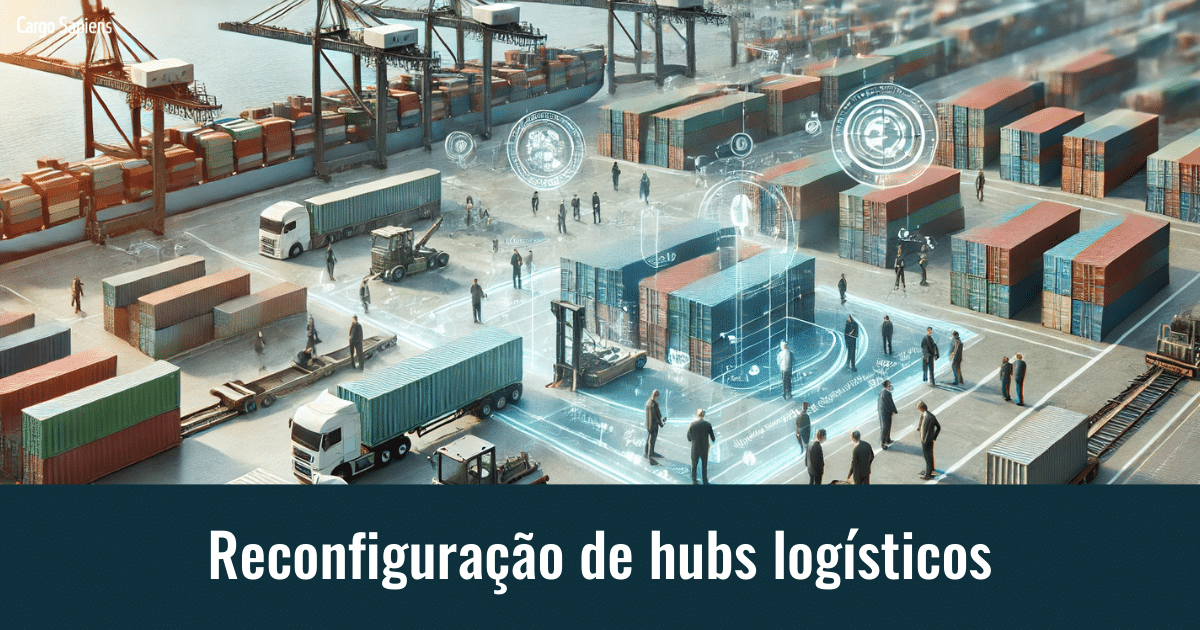
The reconfiguration of global supply chains has ceased to be a one-off response to recent crises and has become a structural change in international trade. By 2026, the reconfiguration of logistics hubs Trade corridors have become a critical factor for competitiveness, risk, and long-term investment decisions.
For boards and C-level executives, this discussion goes beyond operational efficiency. It's about understanding where to position assets, how to structure logistics networks, and how the reconfiguration of logistics hubs influences predictability, total cost, and sustainable growth.
What is changing in global trade flows?
In recent years, excessively concentrated global supply chains have proven fragile in the face of geopolitical, climatic, and regulatory shocks. In response, companies and governments have begun to encourage diversification. routes, the regionalization of suppliers and the strengthening of strategic logistics hubs.
This movement is reshaping global trade flows, with new hubs gaining relevance and traditional corridors being reevaluated from the perspective of cost, risk, and response time. The reconfiguration of logistics hubs is no longer an abstract trend but is materializing in concrete investment decisions and strategic positioning.
Second analysis A recent development in the North American market, Port Laredo, for example, has ceased to act merely as a transit point and is consolidating itself as an integrated distribution and trade center, reflecting the growing strategic importance of logistics hubs in the reorganization of global supply chains.
Why have logistics hubs entered the board's agenda?
A reconfiguration of logistics hubs It's no longer just a technical decision. Today, it directly influences:
- total transportation and storage costs;
- Response time for strategic markets;
- exposure to geopolitical and regulatory risks;
- need for capital invested in inventory;
- Flexibility to scale or redirect operations.
According to the board, decisions related to the reconfiguration of logistics hubs have an impact. return on investmentfinancial predictability and the sustainability of the long-term strategy.
The specific impact on Brazilian companies
For Brazilian companies, the reconfiguration of logistics hubs This becomes even more relevant. The distance from major consumer markets and the dependence on maritime transport make the choice of hubs and corridors a strategic decision for... cost reduction and risk mitigation.
At the same time, recent investments in infrastructure and multimodal integration are creating opportunities for the reconfiguration of logistics hubs to be used as a lever for international competitiveness.
The risk of decisions based solely on the short term.
A common mistake during periods of change is making logistical decisions based solely on immediate cost. Such choices may generate short-term savings, but they increase exposure to structural risks in the medium and long term.
When hubs and corridors are not evaluated from a strategic perspective, companies tend to face:
- Over-reliance on a few entry or exit points;
- difficulty in reacting to global disruptions;
- High costs during times of crisis;
- loss of flexibility for international expansion.
According to the board, this type of risk rarely appears explicitly in financial reports, but it quickly materializes in adverse scenarios.
The new role of logistics in strategic planning.
In an environment of global reconfiguration, logistics and supply chain become central variables in corporate strategic planning.
More mature companies use logistics data to:
- to simulate scenarios of market expansion or contraction;
- To assess the impact of regulatory or geopolitical changes;
- to decide on infrastructure investments and partners;
- Align logistics, finance, and business strategy.
This level of integration transforms logistics into an instrument to support executive decision-making, not just an execution function.
Reflections for boards and executives
Given the reorganization of global flows, the key questions for leaders are straightforward:
- Are our logistics hubs and corridors aligned with the company's long-term strategy?
- Do we have enough flexibility to redirect operations in disruptive scenarios?
- Current logistics decisions either support growth or create it. hidden risks?
Answering these questions is essential for building more resilient and competitive supply chains.
Conclusion
A reconfiguration of logistics hubs Trade corridors are one of the most relevant movements in international trade in 2026. For Brazilian companies, it represents both a challenge and an opportunity to reposition their supply chains in a more resilient way.
Bringing the reconfiguration of logistics hubs to the center of the board's agenda allows for more informed decisions, aligned with corporate strategy and prepared for a more volatile global scenario.
Do you want to assess whether your company's logistics structure is prepared for this new global scenario?
Learn how Cargo Sapiens It helps leaders gain visibility, compare scenarios, and make strategic decisions based on reliable data.