
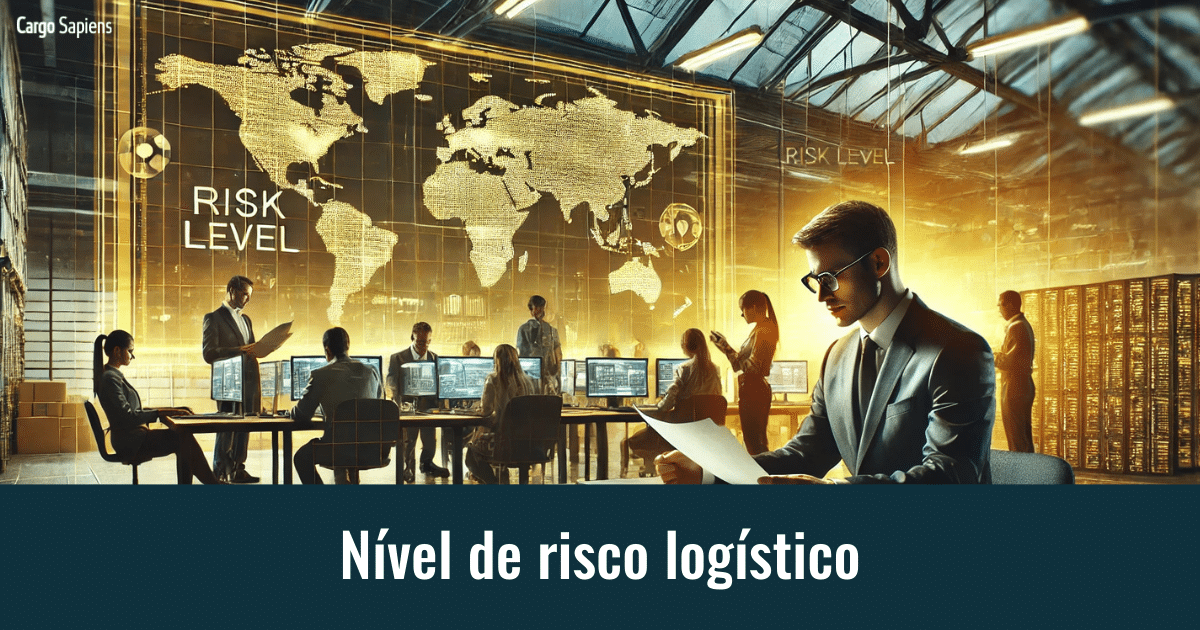
O risk level In global operations, it rarely arises from a single critical event. In most companies, it is built quietly, from seemingly small logistical decisions made over time.
Route selection, freight contracts, supplier concentration, recurring operational exceptions, and low visibility all contribute to a cumulative effect. By 2026, understanding how the level of logistical risk accumulates will have become essential to protecting margins, continuity, and reputation.
Logistics risk is not an event, it's a system.
Many organizations still associate logistical risk with extreme events: strikes, conflicts, route blockages, or global crises. These events matter, but they alone do not explain the real exposure. Structural logistical risk arises when the operation depends excessively on:
- single or inflexible routes;
- rigid and unrevisable contracts;
- suppliers with no viable alternatives;
- manual or fragmented processes;
- decisions without consolidated data.
Second reviews According to the World Economic Forum on risk in global supply chains, highly optimized but less diverse systems exhibit greater fragility in stress scenarios. In this model, the problem is not the crisis itself, but the inability to absorb it.
Where the level of risk really lies.
O risk level It rarely appears clearly in executive reports. It usually manifests itself indirectly, through signs such as:
- growth in the number of operational exceptions;
- emergency costs are becoming more and more frequent;
- Business decisions revised after logistical problems;
- increased inventory to compensate for shortages predictability.
Reports UNCTAD reports indicate that companies with low logistics visibility tend to react to risk after the financial impact has already occurred, increasing total cost and volatility. These symptoms indicate that the risk is already present, even if it has not yet been quantified.
The invisible cost of poorly managed risk.
One of the biggest challenges of risk level The logistical issue is that it rarely appears as an explicit line item in the financial results. It is diluted by a gradual loss of margin. working capital immobilized assets, deterioration of service levels, and erosion of trust from customers and partners.
According to a studies According to the International Monetary Fund's study on international trade, logistical shocks amplify economic impacts when companies lack mechanisms for anticipation and adaptation. In other words, untreated risk does not disappear—it becomes a distributed cost.
Risk level as a strategic decision variable.
Treat the risk level Focusing solely on operational risk limits decision-making capacity. When logistical risk is brought to the strategic level, it begins to influence choices such as:
- Which markets to prioritize;
- how much capital to commit to expansion;
- how aggressive can be pricing;
- What level of dependence on routes and partners is acceptable?
Reports Studies from the World Trade Organization indicate that the most resilient companies are those that integrate logistical risk into strategic decision-making, and not just crisis response. In this context, risk ceases to be the exception and becomes a planning variable.
How can leaders assess risk without paralyzing operations?
Managing risk does not mean eliminating uncertainty, but make it visible and manageableSome approaches help leaders assess the level of risk without hindering decisions:
- Compare alternative logistics scenarios;
- Map critical operational dependencies;
- assess the frequency and impact of exceptions;
- Analyze past decisions that generated emergency costs.
These elements offer clear signals about where the risk is concentrated and where decisions can be adjusted.
Conclusion
In 2026 the risk level In global operations, risk is not determined solely by external factors. It is largely a result of how logistical decisions are made over time. Companies that make risk visible are able to make clearer decisions, protect margins, and avoid strategic surprises.
The others remain exposed, even when they believe they are operating efficiently. Reducing risk begins with identifying where it accumulates.
Learn more about us Cargo Sapiens and understand how leaders are incorporating logistical risk into strategic decisions, avoiding surprises that compromise margins, continuity, and growth.