
A logistics has evolved from an operational function to a strategic axis within companies, gaining prominence in decisions that directly impact the performance and competitiveness of the business. In an increasingly competitive and globalized market, it is the link that connects companies to their customers with agility, efficiency and lower cost.
Understand the pillars of modern logistics and learn how it can transform your business results — or boost your career. This is a good starting point for those looking to update themselves and grow in the field.
In this article, you will discover what logistics is, how it works in practice, its main types, activities and how to make your company's logistics more efficient.
What is logistics?
A logistics Logistics is the area of activity responsible for organizing and enabling the flow of products, from their origin to their final destination. Its impact goes beyond the company's internal operations — it directly influences the customer experience and business results. Present in different segments — from industry to retail, from services to the public sector — logistics is a strategic pillar to ensure that products and services are available in the right place, at the right time.
This area integrates activities such as transportation, storage, inventory control, and order processing, coordinating physical resources and information to ensure agility, accuracy, and availability. When well managed, logistics contributes to cost reduction, optimizes processes and increases competitiveness, promoting faster and more efficient deliveries. This translates into greater customer satisfaction and significant operational gains.
What is the function of logistics?
A logistics In practice, its objective is to precisely coordinate the flow of materials, ensuring that everything arrives where it should, on time, and with the best possible use of resources. Whether conducted internally or outsourced to third-party logistics providers (3PLs), its presence is strategic in areas such as commerce, industry, and transportation.
It encompasses all stages of the flow of materials, information, and resources, from supplier to end consumer. In retail, for example, it's present from the receipt of goods to delivery to the customer, requiring planning, control, and integration between systems. Beyond moving cargo, logistics moves the world. It enables our daily consumption and sustains entire production chains.
In Brazil, the sector has great potential for expansion. According to Abdib, the private sector is expected to invest more than R$124 billion between 2022 and 2026. However, only those who are prepared will be able to take advantage of this growth. The shortage of qualified professionals is a reality, as pointed out Robert Half study. Therefore, knowing the market, understanding the types of logistics and how to apply these concepts in practice is the first step to standing out.
Understanding this complexity is essential to optimize processes, reduce costs and improve customer experience. In this context, technology becomes a great ally, offering solutions that automate routines, increase operational visibility and help make smarter decisions.
How does logistics work?
A logistics It operates based on strategic planning that organizes the flow of materials and products from their origin—such as the purchase of inputs—to final delivery to the customer. Each stage is designed to ensure agility, control, and efficiency throughout. supply chainThe process begins with identifying demand and defining the actions needed to meet it, whether through the production or acquisition of goods.
This then involves moving items to distribution centers, where they are stored, managed, and prepared for shipment. During this journey, activities such as packaging, labeling, and inspection are performed to ensure product quality. Inventory control is another key aspect: it involves forecasting demand, organizing orders, and maintaining optimal levels to avoid service failures.
In the most, the logistics manages supplier relationships, receiving and organizing raw materials with a focus on continuous availability. After production, finished products are distributed to the end customer or sales channels. This distribution may utilize different methods. modes of transport (road, air, rail or sea) chosen according to the delivery time and location.
Each sector — commerce, retail, services and the public sector — has its own logistical peculiarities. Therefore, professionals who understand the specificities of their segment and master the company's logistical structure will have a better chance of standing out in this increasingly demanding market.
How important is logistics?
The importance of logistics Logistics has gone from being merely operational to a strategic component of organizations. It directly impacts company performance, the quality of services provided, and the customer experience. Effective logistics management ensures:
- fast and accurate deliveries;
- resource optimization;
- Waste reduction and process optimization
- greater productivity;
- competitive advantage in the market.
Furthermore, it strengthens the supply chain and supports growth in a structured manner.
The logistics sector has a relevant weight in the national economy. According to ILOS, logistics costs in Brazil reached 18,4% of GDP in 2023 — the highest rate ever recorded. This reinforces the need for modernization, investment in technology and greater efficiency to ensure competitiveness in a challenging scenario.
What are the benefits of logistics for companies?
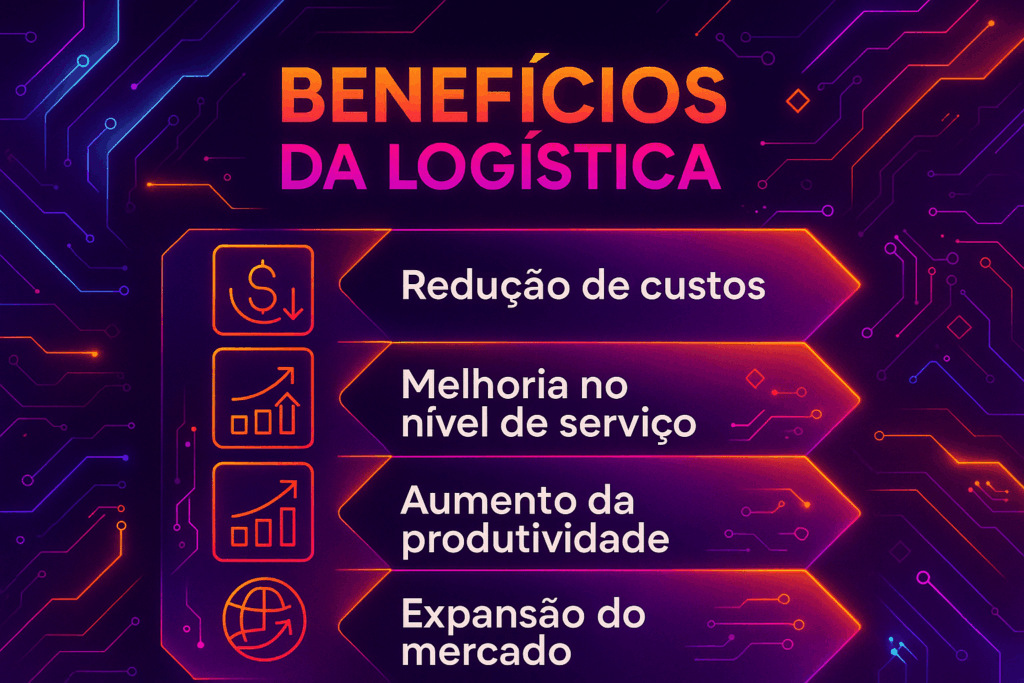
The main benefits of logistics for companies are:
- cost reduction;
- improvement in service level;
- increased productivity;
- market expansion.
Reduced costs
A logistics helps reduce costs through intelligent route selection, effective inventory control, proper use of storage space and elimination of rework.
Service level optimization
With well-defined processes, it is possible to deliver faster, meet specific customer requirements, and ensure greater safety in product transportation.
Productivity increase
Efficient logistics management reduces unnecessary operational tasks, freeing up time and resources for activities that truly add value.
Market expansion
Well-organized logistics operations make it possible to reach new territories, improve service in more distant regions and win over more demanding customer profiles.
What activities are developed in logistics?
The activities of the logistics Business processes encompass several integrated operations that support supply chain performance. These include:
- route and load planning;
- inventory control;
- product storage;
- order management;
- freight audit;
- payment management;
- organization of operational yards;
- transport;
- administrative support.
All these actions are carried out in alignment with the company's main activity, reinforcing the efficiency of the business as a whole.
What are the logistics support activities?
There are some complementary activities that support the logistical processes key factors, ensuring that everything works in a coordinated and efficient manner. They are essential for meeting operational goals and ensuring the supply chain's performance. These include:
- Storage
- Material handling
- Packing
- Procurement of supplies
- Product programming
- Information system
Storage
Responsible for the physical organization of goods, storage ensures that products are available at the right time, preserving their integrity and optimizing space. A good storage system involves adequate layout, inventory control and management of internal flows, which contributes to cost reduction and agility in operations.
Material handling
This involves the internal movement of products within warehouses or distribution centers. It includes tasks such as loading, unloading, stacking and moving loads. Careful execution prevents damage to items and ensures safe operations.
Packing
It goes beyond protection: packaging facilitates product identification, separation, and transportation. It involves choosing the right material, applying barcodes, using seals, and using pallets, all with a focus on preserving the merchandise and maintaining organization. logistics.
Procurement of supplies
It is the process that ensures the supply of materials needed to keep the operation running. It includes supplier selection, commercial negotiations, quality control and payment management, always seeking a balance between cost, deadline and reliability.
Product programming
Plans production based on demand forecasts. Involves defining volumes, manufacturing sequence, resource availability and schedules. This planning is crucial to ensuring the appropriate pace of deliveries, especially in retail.
Information system
Ensures integration and data flow between the sectors involved in the logistics chain. The use of specialized technologies and software improves communication, enables real-time monitoring, and increases operational efficiency.
What are the types of logistics?
The main types of logistics are:
- Supply logistics
- supply logistics
- Production logistics
- Distribution logistics
- Reverse logistic
- Green logistics
- 3PL (Third Party Logistics)
- 4PL (Fourth Party Logistics)
1. Supply logistics
It takes care of the entry of raw materials and inputs necessary to keep production running. It involves the acquisition and transportation of essential materials, avoiding downtime, reducing storage costs and maintaining a continuous production flow.
2. Supply logistics
Focuses on inventory management and the supply of items used in production. Its role is to ensure a balance between demand and availability, preventing excess or shortages and contributing to the efficient use of space and financial resources.
3. Production logistics
Organizes the flow of materials within the production line. Acts in the movement between production stages, optimizing time, reducing waste and maintaining production at a synchronized pace.
4. Distribution logistics
Ensures that finished products arrive at the right destination at the planned time. It covers everything from storage and separation to transportation and delivery, and is key to customer satisfaction and the company's reputation.
5. Reverse logistics
Manages the return of goods for reuse, exchange, disposal or repurposing. Fundamental to sustainability policies, it also handles returns, defective products or leftover materials.
6. Green logistics
Incorporates practices that reduce the environmental impact of logistics operations. Uses clean technologies, prioritizes more efficient routes, reduces waste and promotes recycling, integrating environmental responsibility into the business strategy.
7. Integrated logistics
Connects all logistical stages and sectors of the company for unified supply chain management. It promotes internal communication, streamlines processes and increases precision in operations with a systemic view of the business.
8. 3PL (Third Party Logistics)
Refers to the outsourcing of logistics functions such as transportation, storage and distribution. By delegating these activities to specialized companies, the organization gains focus on its core business and operational flexibility.
9. 4PL (Fourth Party Logistics)
It goes beyond 3PL by assuming complete coordination of the logistics chain, integrating several service providers. It acts as a strategic partner, managing the entire operation and ensuring more efficient solutions, especially in complex situations such as specialized transportation.
What are the challenges of current logistics?
The main challenges in logistics are related to the advancement of globalization, combined with the rapid pace of technological innovation, market development, and intense competition, which force companies to seek efficiency and innovation to remain competitive and expand their operations. In this context, logistics appears as a strategic area, capable of offering solutions that support entry into new markets and optimize performance in already consolidated operations.
With more demanding consumers, who value fast deliveries, fair prices and personalized service, logistics has become a key element in ensuring a positive purchasing journey. Reducing costs, improving deadlines and offering an experience aligned with customer expectations have become essential goals.
How to plan your logistics?
A well-structured and constantly evolving logistics operation brings benefits that go beyond productivity: it directly impacts the customer experience and contributes to the company's sustainable growth. To ensure fast deliveries and a balanced inventory, it is essential to invest in planning and management. Check out some practices that help in this process.
1. Organize and control inventory
Organize your demands accurately and maintain control over stocks to avoid both accumulation and lack of products or supplies.
2. Integrate sectors and align processes
Prioritize integration between sectors: align processes and connect areas through technology. Integrated logistics provides a complete and strategic view of the supply chain.
3. Optimize inventory
Optimize inventory management from the start: define what should be stored, in what quantity, when to replenish, where to allocate products and how to preserve their quality during storage.
4. Choose the best partners
Choose your logistics partners, suppliers and carriers carefully. Evaluate factors such as cost-benefit, service reliability and ability to adapt to the company's demands.
5. Train and value your team
Develop your logistics team with training, incentives, recognition and constant feedback on performance. Well-prepared teams make all the difference in the final result.
6. Value good packaging
Take care of packaging: it's a fundamental part of the customer experience. Ensuring products arrive in perfect condition involves paying attention to both the type of packaging and how it's stored. Test packaging and storage materials under adverse conditions to ensure durability, reduce losses, and prevent returns.
7. Monitor performance
Continuously evaluate logistics processes. Use KPIs, customer surveys and internal audits to identify flaws and promote consistent improvements.
8. Set achievable deadlines
Meet deadlines: this is a basic requirement that is crucial to the company's image. Be sure to have a margin of safety when promising delivery dates and do not commit to deadlines that you cannot meet. Punctuality builds credibility and strengthens your reputation in the market.
Invest in technological tools
Invest in technological solutions. Management, tracking and automation tools optimize control and communication between those involved. Give preference to cloud systems, which offer remote access and greater flexibility.
How can technology make your logistics more efficient?
A company's competitiveness depends directly on the efficiency of its logistics processes, which are present in several areas of the business and have the potential to improve the entire operation. Making this sector more strategic means reducing costs, speeding up deliveries, improving service quality and increasing customer satisfaction.
Logistics 4.0
Logistics 4.0 is revolutionizing supply chain management with solutions that increase agility, improve service, and offer greater flexibility to handle increasingly complex demands. With the advancement of the omnichannel model, integrating physical and digital channels has become essential. Today's consumers expect different delivery and pickup methods, as well as fast service, which requires a logistics synchronized, automated and highly connected.
Digitalisation
Technology is the foundation of this transformation. With it, it's possible to automate tasks, improve tracking, and increase visibility. logistics chain. Digitalization redefines the way operations are planned, executed, and monitored, offering significant gains in accuracy and performance.
management software
Management software plays an essential role in this scenario, offering a unified view of the entire logistics flow—from storage to delivery. Digitization allows real-time monitoring of operational data, facilitating quick decisions and timely adjustments. Furthermore, automating processes frees up the team to act more strategically.
The impacts of this evolution are broad: companies begin to operate more efficiently, optimizing routes, reducing delays, and minimizing failures. Scalability also benefits, with systems capable of supporting increased demand without losing performance. With less waste and greater control, operational costs decrease, freeing up resources for other areas of the business.
What types of technological resources can be used in logistics?
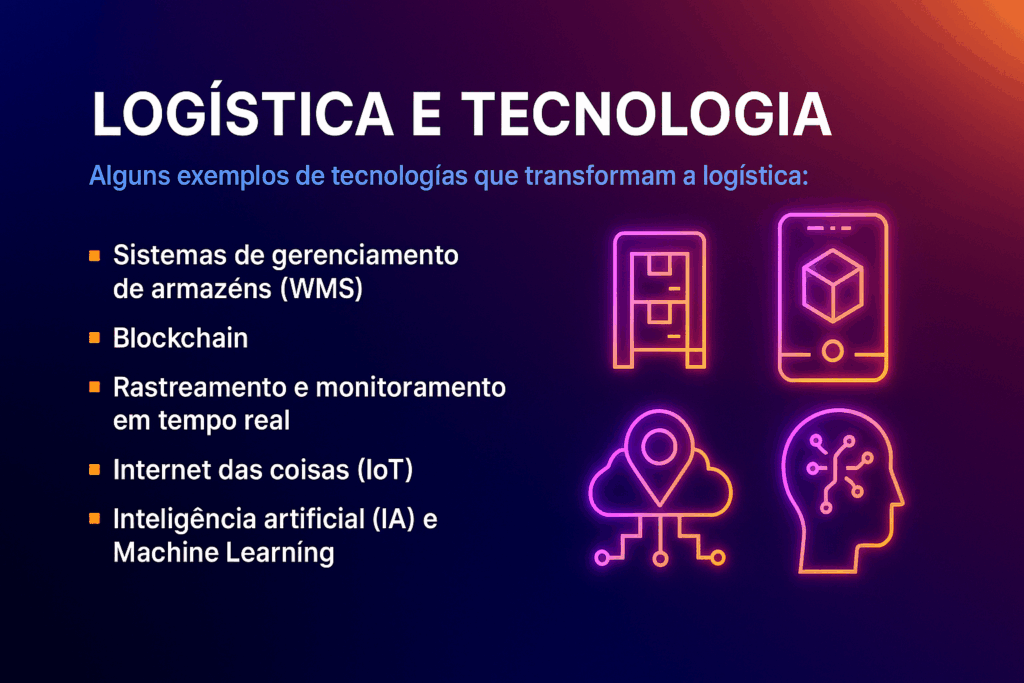
Some examples of technologies transforming logistics include:
- Warehouse Management Systems (WMS)
- Blockchain
- Real-time tracking and monitoring
- Internet of Things (IoT)
- Artificial intelligence (AI) and Machine Learning
Warehouse Management Systems (WMS)
They automate inventory management and increase accuracy in receiving, storage, separation and shipping operations.
Blockchain
It guarantees transparency and security in the recording of transactions throughout the entire logistics chain.
Real-time tracking and monitoring
It uses GPS and sensors to monitor the location, integrity and conditions of loads, promoting safer and more efficient deliveries.
Internet of Things (IoT)
It uses connected sensors to monitor variables such as temperature and humidity, ensuring full visibility over products in transit.
Artificial Intelligence (AI) and Machine Learning
Analyzes large volumes of data to optimize routes, forecast demand, identify bottlenecks, and propose solutions tailored to the specific needs of each operation. These and other tools are redefining the way logistics is driven, making processes more agile, cost-effective, and focused on the customer experience. And with constant technological evolution, new solutions are expected to continue emerging, further transforming the sector in the coming years.
How to achieve greater efficiency in logistics?
Today, solutions exist to transform your company's logistics operations into a more efficient, intelligent, and connected operation. With cutting-edge technology and customized solutions, these platforms offer full visibility into the freight quoting process, enabling automation of activities and greater efficiency in contracting decisions.
A prominent example is the Cargo Sapiens By integrating data and operations into a single system, it helps reduce costs, increase productivity, and enhance customer service. Whether it's to gain agility, improve decision-making, or expand logistical reach, it's a strategic partner for companies looking to grow efficiently and innovatively.
Conclusion
As we have seen, the logistics has gone from being a support sector to an essential strategic component of a company's success. Its role goes far beyond transportation: it encompasses planning, inventory management, distribution, process automation and, most importantly, the customer experience. With the evolution of technology and digital transformation, companies now have the opportunity to make their operations more agile, intelligent, and connected.
The adoption of innovative solutions, such as tracking systems, automation, and predictive analytics, allows for greater control, cost reduction, and real gains in productivity and competitiveness. Furthermore, we've seen that efficient logistics directly impacts sustainable business growth, from supply to final delivery—and that understanding each stage of this process is crucial to addressing current market challenges.
Take the next step towards logistics efficiency: check out our content on freight and understand how to make it the difference you needed to further optimize your operation.