
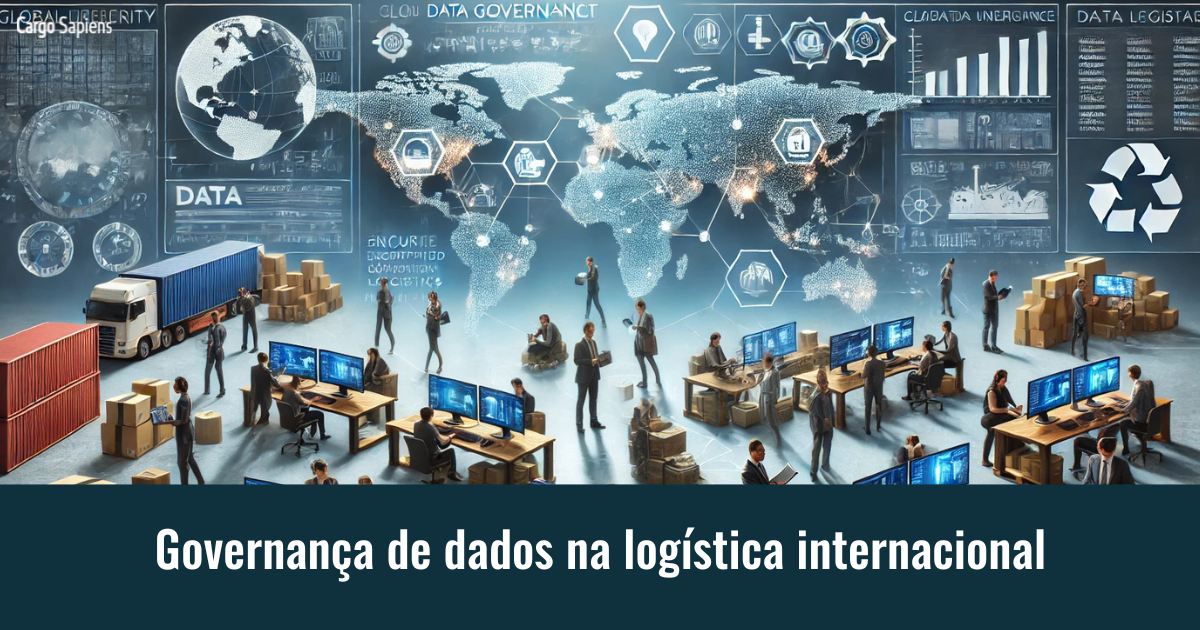
data governance This is what separates an "operable" international supply chain from a truly governable one. In international logistics, data is not just for reporting status: it defines what the company can promise the customer, how much capital is tied up in transit, how much each decision costs, and what the regulatory risk associated with each shipment is.
When governance is weak, a company may still be able to move cargo, but it loses predictability, scale, and margin. When governance is strong, decisions cease to be reactive and become repeatable: cost, time, and risk become clear, auditable criteria connected to the P&L.
Next, see how management should frame data governance as a discipline for competitiveness and which structural decisions unlock value.
Why data governance has become an executive agenda item.
The world of international trade is moving toward a standard where information needs to be structured, reusable, and exchanged digitally with governments and partners. This is not an abstract trend: it is already being demanded.
In maritime, the IMO It points out that amendments to the FAL Convention make it mandatory for authorities to establish and use Maritime Single Window systems for the electronic exchange of information required for ships to call at ports. UNECE It also highlights that, starting January 1, 2024, governments must use this single digital platform to exchange information with ships during port calls.
In Europe, the eFTI Regulation This drives the replacement of paper documentation with electronic transport data across all modes of transport. The message for those operating international supply chains is simple: the more borders and transport require digital data, the higher the cost of relying on manual processes and disconnected databases.
For the C-level, data governance It ceases to be an "IT issue" and becomes a matter of margin protection and reduction of operational and regulatory risk.
What does data governance mean in international logistics?
Data governance is not about having "a system," it's about having a decision-making model to ensure that critical data is:
- reliable (quality and consistency);
- traceable (lineage and audit);
- standardized (same definition throughout the organization);
- interoperable (capable of being exchanged with partners and authorities);
- Insurance (protection and access control).
This combination creates a corporate capability: to transform logistical events into economic and risk decisions, with transparency.
Where companies lose money when there is no data governance.
Without data governanceThe problems tend to repeat themselves at the same critical points in the chain: lack of transparency in total cost, decisions based on conflicting versions of the truth, compliance and confidentiality treated as an exception and with low capacity for automation at scale.
- Total cost opaque: freight, fees, storage, and exceptions are scattered. The company "sees the cost," but cannot explain the cause and responsibility.
- Decisions based on conflicting versions of the truth: logistics, foreign trade, procurement Finance and other departments operate with different definitions for the same fields (lead time, incoterms, status, costs, dates).
- Risk and compliance treated as exceptions: documents and information are "chased after" only when required, generating urgency, rework, and exposure.
- Low capacity automationWithout standardized data, all automation becomes a handcrafted and fragile project.
The cost of this is cumulative: each exception becomes an emergency, an emergency becomes a cost, and that cost translates into lower margins.
Global standards show the way: standardization and data exchange.
Two principles appear repeatedly in guidelines from international organizations and help the board to separate "cosmetic digitization" from real transformation: reducing information redundancies (submitting once and reusing) and adopting standards that guarantee interoperability, allowing data to circulate consistently between areas, partners, and authorities.
Submit once, reuse as much as possible.
A IMO This reinforces the idea that authorities should combine or coordinate the electronic transmission of data so that information is submitted only once and reused to the greatest extent possible. This principle is not just for governments: it's a logic of efficiency and control within companies.
Harmonization and a common language for cross-border data
The World Customs Organization describes the WCO Data Model as a foundation for global trade interoperability and a universal language for cross-border data exchange, enabling Single Window and analytics. Currently available... IATA It defines ONE Record as a data sharing standard with a common model and standardized APIs, aiming for a single view of the shipment.
For C-level executives, the implication is strategic: data governance It's not just about organizing the house. It's about aligning with the standards that are becoming the infrastructure of... international trade.
The four data domains that the board should require to be governed
A practical way to take data governance For the executive level, the goal is to structure the topic by critical domains, clearly defining who is responsible for each one and what metrics demonstrate quality, adherence, and impact on the business.
Master data
Supplier registration, carriers, ports/airports, routes, SKUs, NCM/HS codes, units, terms and conditions, cost centers. Without this, cost and compliance don't scale. Here, quality standards help guide what constitutes "good data". ISO It describes the ISO 8000 series as a reference for data quality principles and a path to improvement.
Transactional data
Quotes, approvals, orders, contracting, invoices, expenses, exchange rates, fees. This is where governance connects logistics to... P&L.
Event data and visibility
Status milestones, timestamps, exceptions, dwell time, delays, deliveries, occurrences. This is where the company transforms operations into predictability and... risk management.
Regulatory and compliance data
Licenses, declarations, documents, market-required attributes, audit trails. With the digitization of single windows and standards such as eFTIThis field is likely to grow in demand and relevance.
The role of C-level executives: governance decisions, not micromanagement.
The board and C-level executives don't need to operate spreadsheets or validate fields. Their role is to define the rules of the game: what data is critical, who is responsible for each domain, what standards are non-negotiable, and how quality, risk, and compliance will be measured and enforced to support decisions and scale.
Define ownership and accountability by domain.
Without an owner, data becomes "no man's land." The design that works in complex companies usually has:
- One executive owner per domain (responsible for impact);
- Data stewards by area (who ensures quality and process);
- IT as an enabler (platform, integration, security).
Establishing standards and a mandatory "corporate dictionary"
Governance begins with semantics. If "lead time" means different things to each person, the dashboard is an illusion. The corporate dictionary is what enables automation and comparability between units and regions.
Create executive metrics for quality and risk.
metrics of data governance They need to appear on the same level as metrics Cost and service. Examples that work well for C-level executives:
- Completeness rate of critical fields per process;
- rework rate due to data inconsistency;
- Average time to resolve exceptions generated by missing data;
- Percentage of shipments with a complete auditable cost and documentation trail.
Security as a requirement for trust and scale.
When data becomes the basis for decision-making and exchange with partners, security ceases to be a checklist and becomes a prerequisite. ISO / IEC 27001 It defines requirements for an information security management system, oriented towards risk management.
For C-level executives, this translates to decisions about:
- Data classification and access by profile;
- segregation of duties (who creates, approves, and modifies);
- Audit trail for critical changes;
- Third-party risk management (partners and integrations).
How a company moves from chaos to data governance that generates ROI.
Em international logisticsThe transition typically fails when it becomes a "generic data program." What works is a roadmap focused on decisions.
Start with an executive use case and expand
Choose a use case that C-level executives feel impacts the P&L:
- reduce exception costs;
- Increase cost predictability per corridor;
- Reduce quotation/contracting cycle time;
- reduce capital locked by variability.
From then on, governance emerges with an economic objective, not as an "organizational project".
Standardize data interfaces with the ecosystem.
If a company operates with multiple partners and modes of transport, external standards accelerate the process:
- WCO Data Model and practices of Single Window as a reference for cross-border harmonization;
- ONE Record in the context of air cargo data and APIs;
- Regulatory directions such as eFTI, pushing for electronic exchange of transport information.
The benefit here is reducing "translations" and fragile integrations, which are one of the biggest hidden costs of scaling up.
Data governance as a competitive advantage
data governance It's not bureaucracy. It's the ability to operate international supply chains with less surprise, more predictability, and faster decisions. In a world of mandatory digital windows, standardization, and increasing demands for structured data, the company that governs data governs cost, time, and risk.
If your organization wants to elevate international logistics to the level of an executive discipline, then... Cargo Sapiens It can help standardize processes, consolidate visibility, and transform data into more predictable decisions, from the quotation flow to the contracting process.