
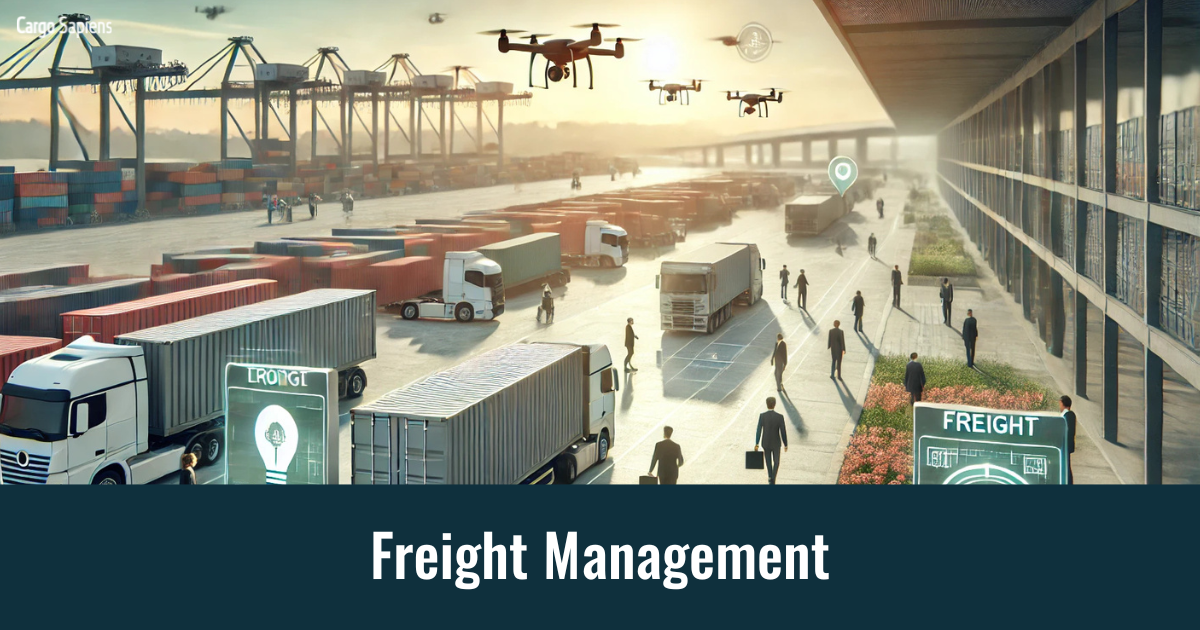
In 2026, freight management It's no longer about "buying freight well" but has become about total cost governance, predictability, and risk. Companies operating international logistics are optimizing not only rates, but also variability, exceptions, compliance, and the quality of the data that underpins each decision.
The practical result is clear: less surprise in the P&L, less urgency in operations, and greater scalability. Below are the most consistent trends emerging in companies that are increasing their maturity in international freight operations during this cycle.
What changed in 2026: predictability became a competitive advantage.
Even when the market signals easing of rates in certain periods, operational instability remains significant. indicator A simple example helps to frame the problem: global ship schedule reliability stood at 61,4% in October 2025, with variations by route and shipowner.
For C-level executives, this type of scenario pushes optimization beyond price: those who govern predictability tend to protect revenue and margin more consistently than those who merely "negotiate better."
Optimization 1: Migrate from freight management to portfolio management.
More mature companies in freight management They treat freight as a portfolio, not as an event. In practice, this means segmenting flows by criticality and designing different policies for each group.
- Critical flows (direct impact on revenue, production line, strategic clients): prioritize predictability: contracts with SLAs Clear, more stable routes, pre-negotiated alternatives, and exceptional governance.
- Tactical flows (less sensitive to timeframes): allow for greater cost optimization: larger windows, consolidation, modal flexibility, and greater exposure to spot markets when it makes sense.
The executive gain here isn't "paying less." It's reducing the invisible cost of reactive decisions, which almost always appear as emergencies and exceptions.
Optimization 2: Redesign the contracting strategy (contract vs. spot) based on risk.
In many markets, the 2026 conversation has once again included renegotiating terms and seeking more favorable contractual conditions as rates soften. However, the correct decision is rarely simply "contract or spot." It's a combination governed by:
- Business sensitivity to variability;
- Cost of disruption and cost of urgency;
- need for guaranteed capacity;
- Risk appetite by corridor and market.
The most common practice among enterprise companies is to set limits: what percentage of the volume can be exposed, on which routes, and with what protection triggers.
Optimization 3: Visibility as a decision discipline, not as tracking.
Many companies still confuse visibility with tracking. Companies that are moving forward in 2026 treat visibility as the basis for decision-making: every logistical event needs to become an input for total cost, forecasting, and... riskThis requires standardized data.
International organizations have been reinforcing this path for years: the WCO describes the WCO Data Model as a basis for interoperability and standardized exchange of cross-border data, supporting initiatives such as Single Window and analytics.
In air transport, the IATA It promotes ONE Record as a standard for data sharing with a common model and APIs, aiming for a single view of the shipment. For C-level executives, the point is straightforward: without standardization, there is no scalability for automation, and without automation, the cost of coordination becomes a permanent tax on international freight.
Optimization 4: Incorporate carbon and regulation into the total cost of freight.
By 2026, regulatory costs will no longer be a "footnote" in some routes. A practical example is... EU ETS For shipping: shipping companies announce that, starting January 1, 2026, they will be required to submit allowances for 100% of verified CO₂ emissions on voyages involving EU ports.
In parallel, the IMO maintains instruments such as the EEXI and the CII as a basis for efficiency and assessment of operational carbon intensity.
What leading companies are doing:
- Model regulatory impact by route and by customer (to avoid surprises in margins);
- Differentiate hiring strategy based on regulatory exposure;
- to demand transparency regarding surcharges and calculation criteria;
- strengthen data governance emissions and compliance and confidentiality for auditing and reporting.
The executive consequence is relevant: freight decisions based on freight management They begin to have a direct effect on pricing, competitiveness, and market access.
Optimization 5: Exception governance to reduce hidden costs
The biggest value leak in international shipping It is rarely included in the negotiated price. It is found in the exceptions: extra storage, reprocessing, delays impacting production, emergencies, demurrage/detention, and document revisions.
Companies that optimize in 2026 create a simple discipline:
- categorize exceptions by root cause (and not by "culprit of the day");
- measure total exception cost (not only logistic cost direct);
- Define owners and reduction targets by exception type;
- Automate alert and decision triggers before they become urgent.
When this governance exists, the company stops "putting out fires" and begins to reduce the frequency of fires.
Optimization 6: Placing the C-level in the right place in the process.
Freight management It doesn't scale when it becomes a sum of local decisions. It scales when the C-level defines the rules of the game.
- Which flows deserve predictability above marginal economics?
- what is the policy of trade-offs between cost, time and risk per corridor;
- Which data is critical and which standard is non-negotiable?
- How the total cost (including regulations and exceptions) will be measured and charged.
This framework creates consistency and reduces conflicting decisions between departments, suppliers, and regions.
What do companies gain when freight management becomes governance?
When freight management It is treated as executive discipline, and the gains tend to appear on three fronts:
- More predictable margins, with less volatility caused by exceptions and emergencies;
- Reducing hidden costs through less rework and fewer reactive decisions;
- It achieves greater scale because the operation no longer depends on tacit knowledge but instead on governed processes and data.
If your company wants to evolve from "freight management" to "international freight governance," it's worth reviewing the architecture: flow segmentation, contracting strategy, data standardization, actionable visibility, and exception governance.
Get to know Cargo Sapiens And see how to structure processes and data to bring more predictability, transparency, and control to international freight, from quotation to contracting.